
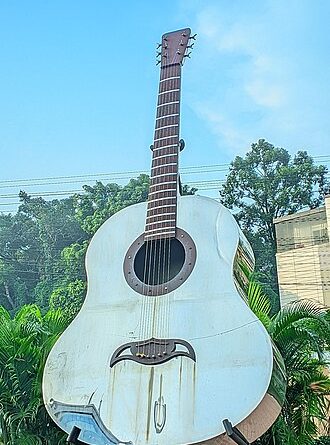
Ayub Bachchu: The Guitarist Who Gave Bangladesh Its Rock Sound
Almost every distorted guitar riff in Bangladeshi rock traces back, directly or indirectly, to Ayub Bachchu. Born in Patiya, Chittagong on 16 August 1962, Bachchu started performing with the band Feelings in 1977 — the same outfit that would later launch James — before joining the band Souls as lead guitarist in 1980, a role he held for a decade across multiple studio albums.
In 1991, Bachchu left Souls to found his own band: Love Runs Blind, known to every Bangladeshi rock fan simply as LRB. The following year, LRB released Bangladesh’s first-ever double album, a technically and commercially ambitious move that had no real precedent in the country’s music industry at the time.
Bachchu is widely credited as the first guitarist in Bangladesh to use distorted guitar tones as a defining part of his sound, a technical shift that shaped how an entire generation of Bangladeshi guitarists — including Ibrahim Ahmed Kamal, Iqbal Asif Jewel, and Ershad Zaman — approached the instrument. Alongside James and the late Azam Khan, he is remembered as one of the “big three rockstars of Bangladesh,” the trio most responsible for turning rock into a mainstream force in the country during the 1990s.
Bachchu died on 18 October 2018. The following year, Chittagong renamed a public square Ayub Bachchu Chattar and installed the “Rupali Guitar” sculpture there in his honour — a rare civic tribute to a musician in Bangladesh, and a measure of how deeply his influence had reached beyond the rock scene he helped build.